SLA — Stereolithography.
High-precision ultraviolet vat photopolymerization engineered for razor-sharp edge definition, micro-fluidic features, and injection-mold surface smoothness without visible layer lines.

How SLA Photopolymerization Works: The 8-Stage Precision Cycle
From voxel island mesh inspection and peel-force mitigation to ultrasonic solvent washing and calibrated 60°C UV post-curing.
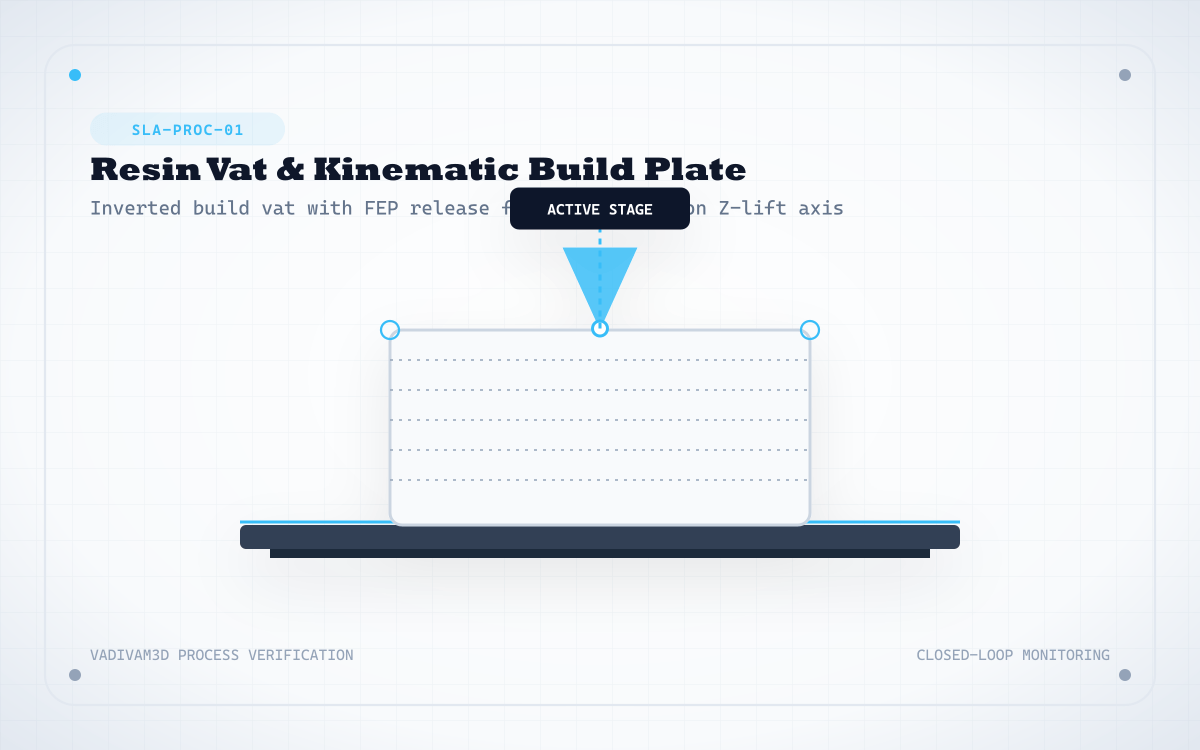
Parametric Mesh Ingestion & Island Analysis
Slice-by-slice voxel inspection for floating overhangs.
Software scans every slice plane to ensure no isolated resin pools form without contiguous attachment to the foundational build scaffolding.
Precision SLA Resin Catalogue
Photocurable thermoset polymers engineered to replicate the mechanical toughness, heat resistance, and cosmetic feel of injection-molded ABS.
SLA ABS-Like Photopolymer Resin
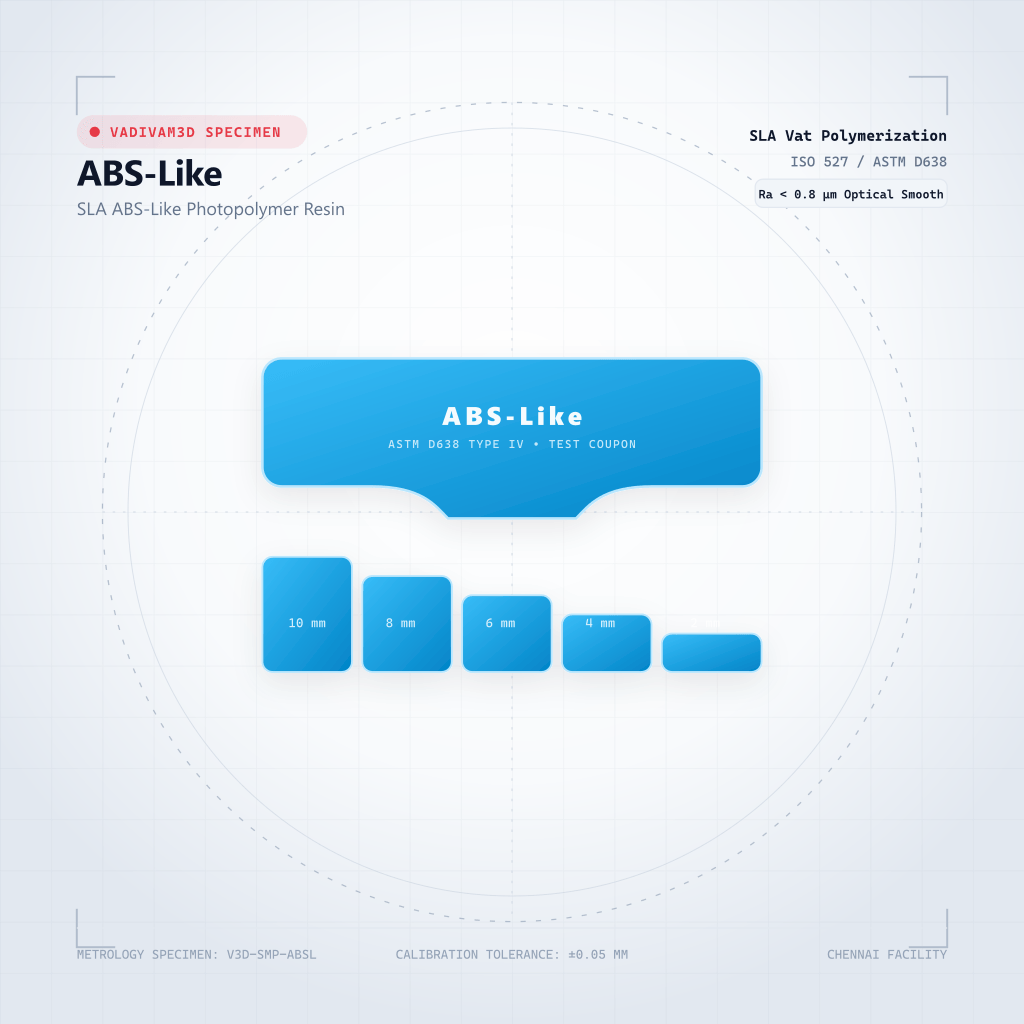
Curable resin environment producing micro-feature detail, smooth surfaces, and clinical dimensional accuracy for Master visual and fit testing.
Ultra-smooth photopolymer finish with sharp edge resolution and zero layer lines.
Engineering Parameters
Recommended Applications
When to Specify SLA Over FDM
While FDM excels at large-format, impact-resistant thermoplastic brackets, SLA is the undisputed leader when surface aesthetics and microscopic feature tolerances dictate success.
0.2 mm Minimum Features
SLA captures fine 0.2mm wall thicknesses, micro-channels, and embossed text illegible on FDM nozzle tips.
Ra < 0.8 µm Surface Finish
Thermoset liquid resin chemically cross-links, eliminating mechanical layer interfaces and porosity for watertight fluid seals.
Uniform Z-Axis Strength
Unlike FDM where Z-axis tensile strength drops by 40%, SLA exhibits near-complete isotropy under mechanical test loads.
Design for SLA Manufacturing (DfAM)
Essential rules for preventing suction cup forces, ensuring complete resin evacuation, and achieving sharp dimensional stability.
Minimum Wall Thickness
Ultra-thin unsupported walls warp during the inverted peel stroke when the build plate separates from the vat FEP film.
Drainage Holes for Hollow Parts
Hollow chambers without drainage create a suction cup effect that tears parts off supports, while trapping uncured liquid resin inside.
Minimum Embossed & Debossed Detail
Capillary attraction can hold uncured resin inside sub-millimeter engravings, obscuring faint text during curing.
Clearance for Moving Assemblies
Uncured resin trapped in micro-gaps can cross-link during post-cure exposure, fusing moving joints permanently.
Thread & Tap Integration
SLA's high optical resolution allows direct printing of precision ISO metric threads down to M3.
Precision Applications in Advanced R&D
Where tolerances below 50 microns and immaculate optical surfaces are mandatory.
Aesthetic Master Patterns
Showcase display models, silicone molding master patterns, and consumer electronics styling validation.

Micro-Fluidic Manifolds
Transparent or translucent diagnostic chips, valve blocks, and internal fluid distribution channels.

Precision Enclosures
Compact smartwatch shells, handheld sensor housings, and snap-fit battery covers requiring zero gap tolerances.

Dental & Clinical Models
High-resolution anatomical jaw models, surgical guides, and orthodontic aligner thermoforming masters.
Technical Frequently Asked Questions
Detailed engineering answers regarding dimensional tolerances, material selections, and production requirements.
Ready to Produce Your High-Precision SLA Parts?
Upload your high-density STL or STEP files for mesh island verification, orientation planning, and instant pricing.