Industrial 3D Printing & Manufacturing Technologies.
Vadivam3D operates specialized additive manufacturing ecosystems spanning thermoplastic extrusion, precision resin photopolymerization, and support-free powder bed fusion—engineered for rapid functional prototypes to production-grade end-use parts.

Select Your Technology Track
Every manufacturing challenge has unique geometric, mechanical, and thermal demands. Explore our dedicated technology disciplines below.

FDM — Fused Deposition Modeling
Industrial thermoplastic filament deposition for functional prototypes, durable tooling fixtures, and carbon-fiber composite components.

SLA — Stereolithography
High-precision UV laser liquid resin curing engineered for microscopic features, razor-sharp edge definition, and injection-mold surface smoothness.

SLS — Selective Laser Sintering
Support-free selective laser sintering for complex internal channels, living hinges, and dense batches of end-use production parts.

Advanced Materials — Extreme Temperature & Flame Retardant
Severe-environment polymers replacing machined 6061 aluminum and brass with continuous service up to 200°C and certified UL94 V-0 safety.
Additive Manufacturing Technology Matrix
A side-by-side engineering evaluation of FDM, SLA, and SLS processes to help you select the ideal manufacturing route for your production volume and mechanical requirements.
| Engineering Parameter | FDM (Extrusion)view → | SLA (Resin Curing)view → | SLS (Powder Fusion)view → |
|---|---|---|---|
Dimensional Accuracy Critical for snap fits, bearing fits, and tight assembly tolerances. | ±0.15 mm or ±0.2% | ±0.05 mm (highest precision) | ±0.10 mm to ±0.15 mm |
Layer Height Range Determines stair-stepping visibility and fine vertical feature resolution. | 100 - 300 µm | 25 - 100 µm (micro-fine) | 60 - 120 µm |
Minimum Feature Size Defines the finest readable text, thin ribs, or micro-nozzle orifices. | 0.8 mm (nozzle limited) | 0.2 mm (sharpest edges) | 0.5 mm |
Surface Finish & Roughness Aesthetic presentation, optical transparency, and liquid sealing. | Ra 5.0 - 12.0 µm (visible layer lines) | Ra < 0.8 µm (injection-mold smooth) | Ra 3.0 - 5.0 µm (matte satin / sugar texture) |
Mechanical Isotropy Predictable structural performance under complex multi-axis shear loads. | Anisotropic (~40% weaker in Z axis) | Nearly isotropic (cross-linked resin) | Isotropic (uniform multi-axis strength) |
Maximum Build Envelope Determines whether large parts can be printed as a monocoque single piece. | 300 × 300 × 350 mm (large format up to 500mm) | 145 × 145 × 175 mm (master patterns) | 200 × 200 × 300 mm (nesting batch) |
Geometric Freedom & Supports Enables internal fluid channels, conformal cooling, and zero support removal scars. | Requires sacrificial support structures | Requires micro-touch tree supports | 100% Support-free (powder bed supported) |
Engineering Material Spectrum Ability to withstand chemical solvents, extreme heat (>200°C), and impact. | PLA, ABS, PETG, Carbon-Fiber, PPS-CF, PC-FR, PPA-CF | ABS-like resins, tough photopolymers | PA12 Nylon, Glass-filled PA12 GF |
Production Batch Scalability Economics and speed when moving from prototype to low-volume production. | Best for 1-20 units & large structural tooling | Best for 1-50 ultra-detailed master units | Best for 20-500+ production end-use units |
Standard Production Lead Time Turnaround time for time-sensitive design validation sprints. | 24 - 48 Hours | 24 - 72 Hours | 48 - 96 Hours (batch cool-down cycle) |
Comprehensive Additive Materials Catalogue
From standard rapid prototyping polymers to aerospace-grade continuous carbon-fiber composites and sintered engineering nylons.
Polylactic Acid
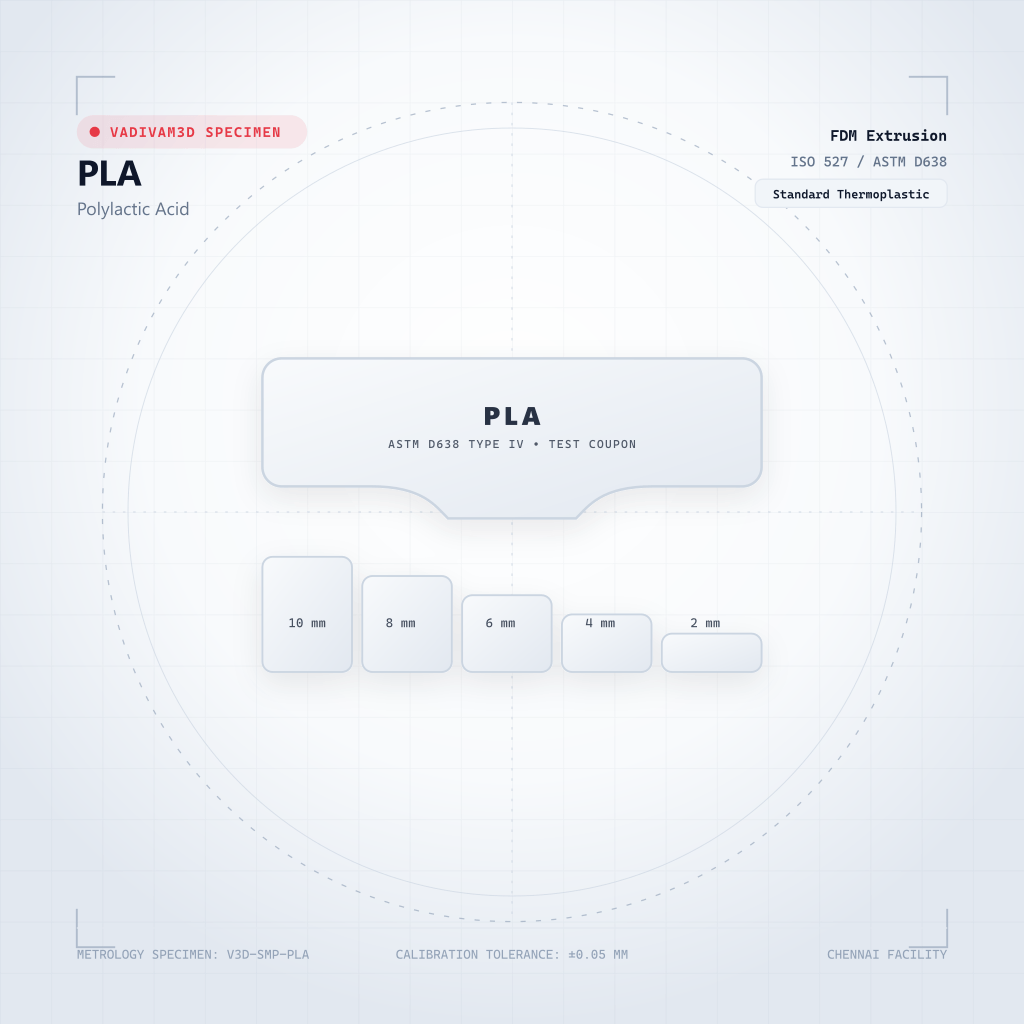
PLA offers crisp detail, minimal warping, and high dimensional accuracy for early-stage visual models and architectural concepts.
Smooth matte plastic aesthetic with clean crisp edge definition.
Engineering Parameters
Recommended Applications
The Industrial Additive Production Pipeline
From digital CAD model submission to Coordinate Metrology validation and dispatch across Chennai and India.
CAD Submission & Verification
Upload your 3D engineering models (STEP, STL, IGES) for automated volumetric parsing.
Our digital pipeline validates watertight manifold geometry, checks surface orientation, and identifies thin walls or potential failure nodes.
Engineered for Demanding Applications
Our additive manufacturing ecosystem supports engineers across every stage of the product lifecycle.

Functional Prototyping
Form, fit, and kinematics verification in engineering plastics before committing to expensive injection mold tooling.

Jigs, Fixtures & Tooling
Lightweight, rigid assembly nests, robotic end-effectors, and drill guides reinforced with high-modulus carbon fibers.

Low-Volume Production
Support-free batch production of 20 to 1,000+ end-use nylon parts with true isotropic strength and internal ducting.

High-Temp Metal Replacement
Severe-environment pump impellers, engine manifolds, and flame-retardant electrical switchgear covers.
Technical Frequently Asked Questions
Detailed engineering answers regarding dimensional tolerances, material selections, and production requirements.
Ready to Scale Your Additive Production?
Send us your 3D engineering models for a rapid DfAM manufacturability audit, material recommendation, and quote.